Fintech · Risk · Inclusion

Peer-to-peer microlending platform

Designing for trust, risk visibility, and financial inclusion at scale — balancing borrower confidence with lender risk signals.

Role
Design Lead
Team
PM, 4 eng, 1 researcher
Timeline
~6 months
Surface
Two-sided platform
0
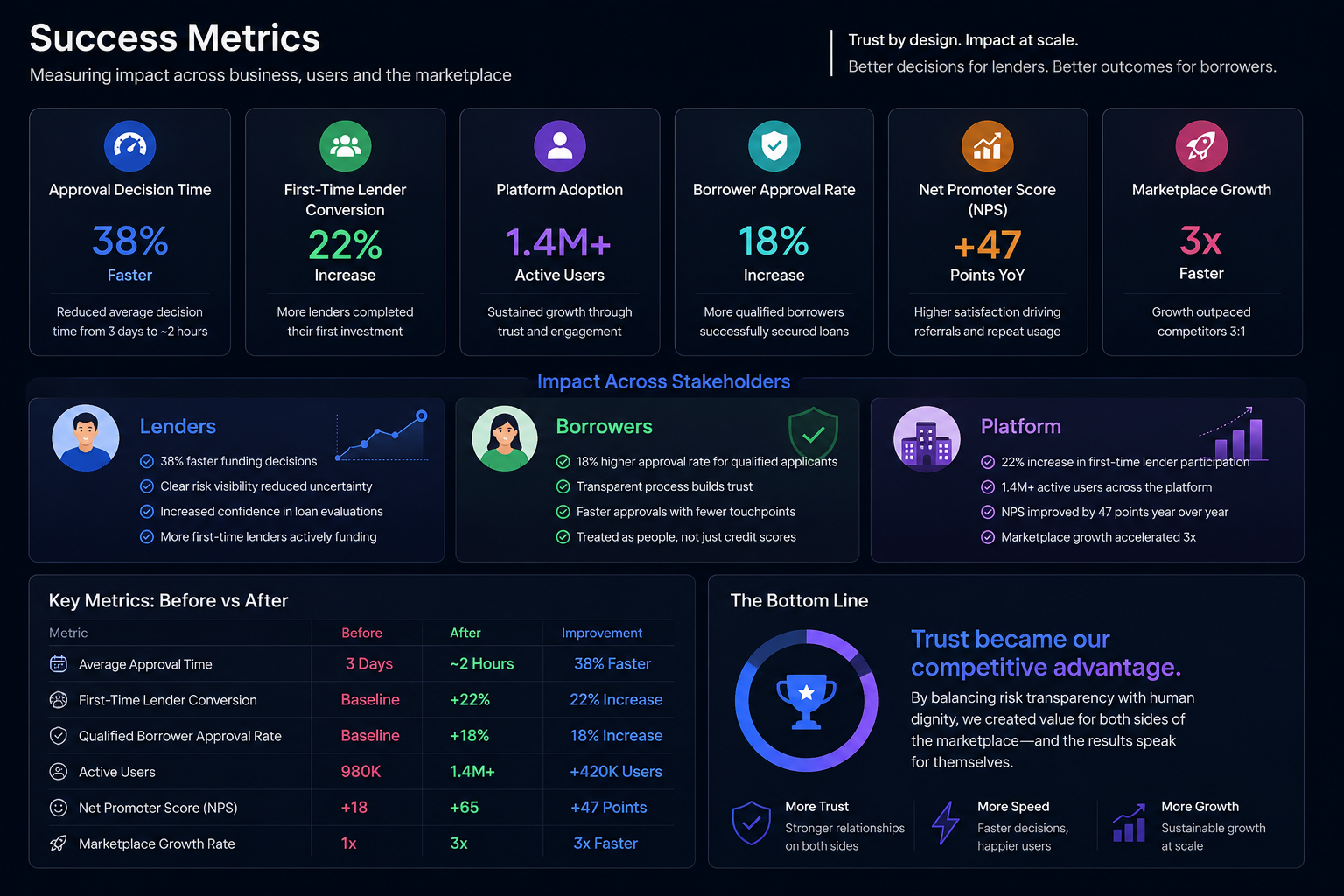
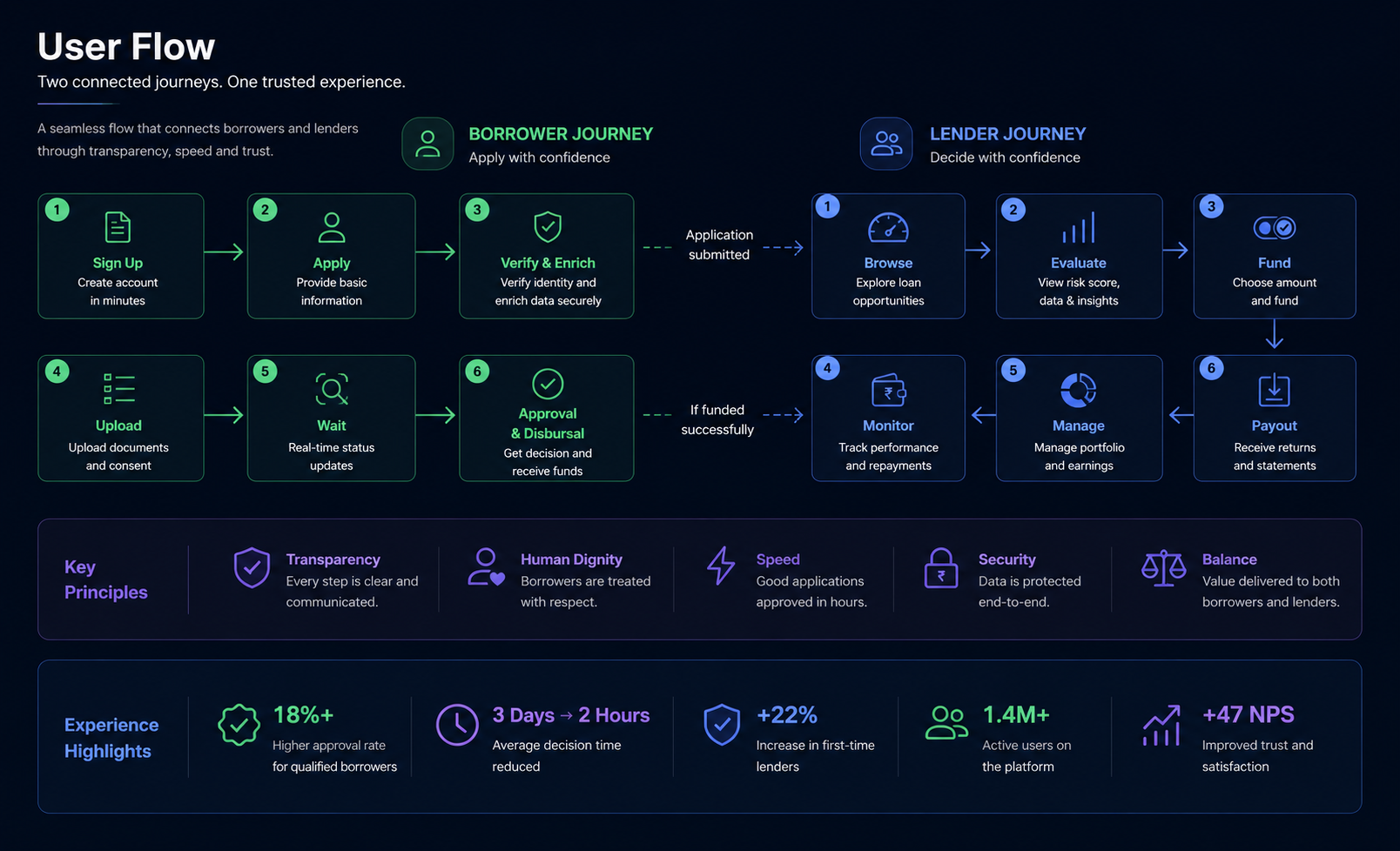
faster loan approval decisions
0
more lenders funding their first loan
0
users across the platform
The stakes

Two sides, opposite needs, one screen

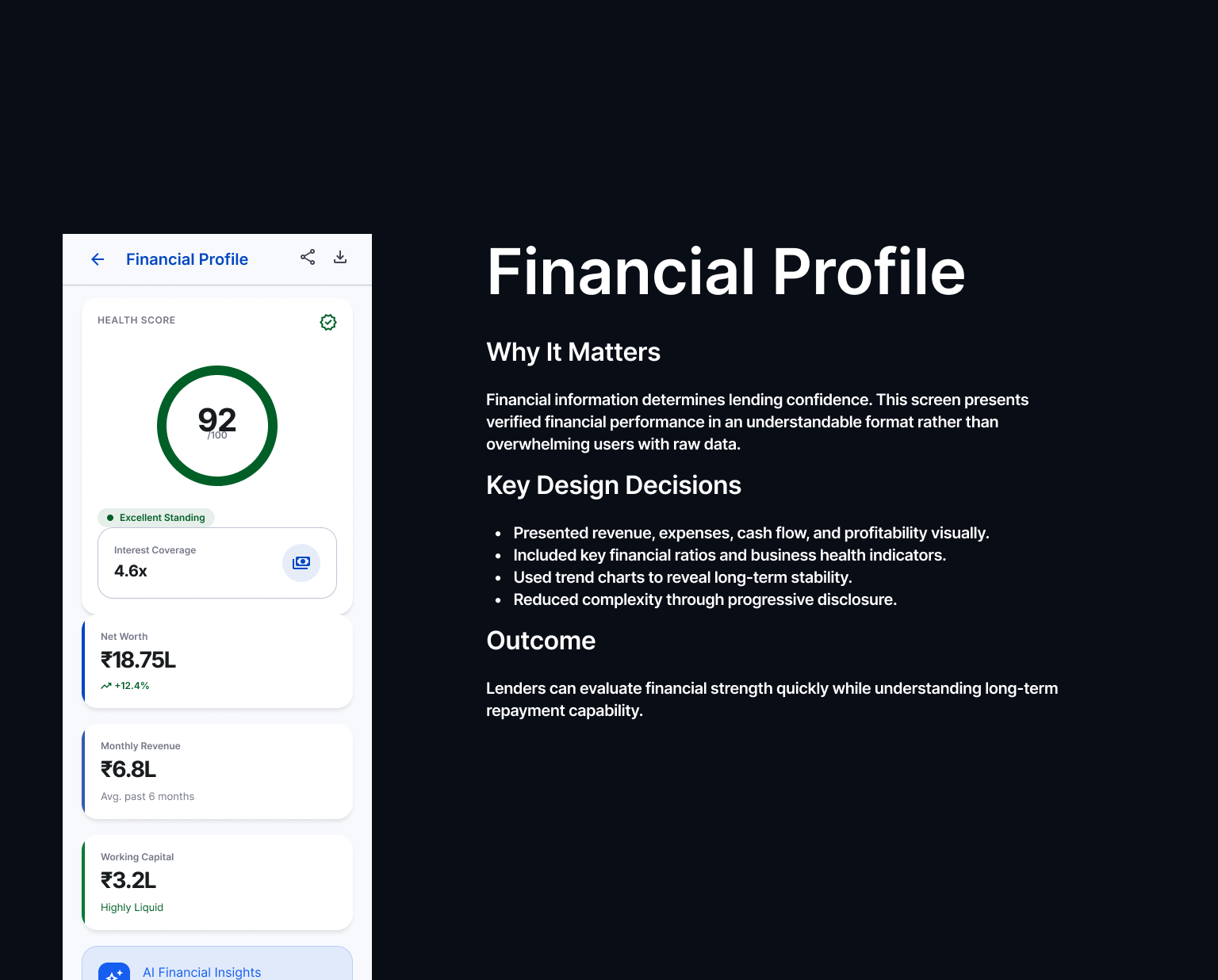
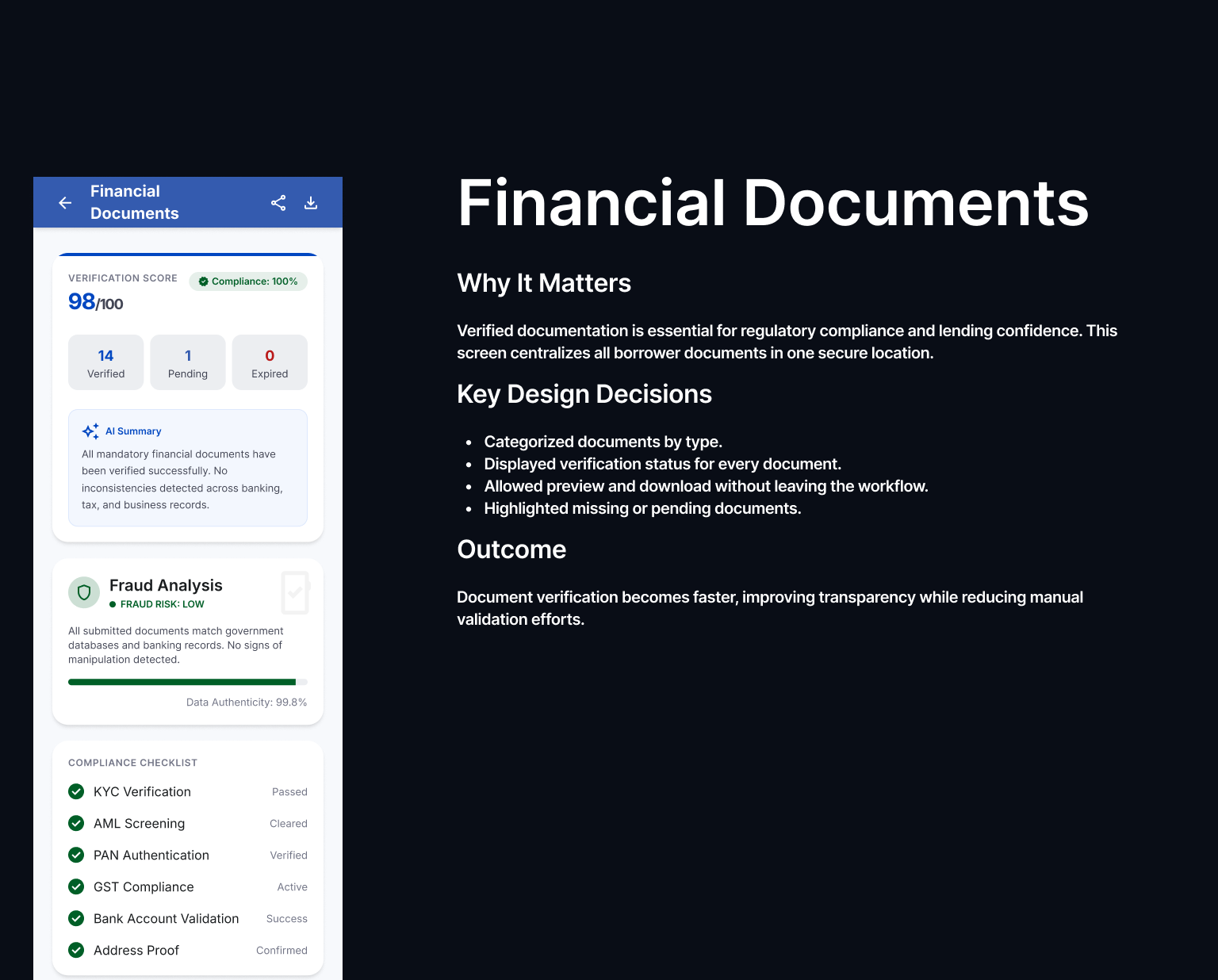
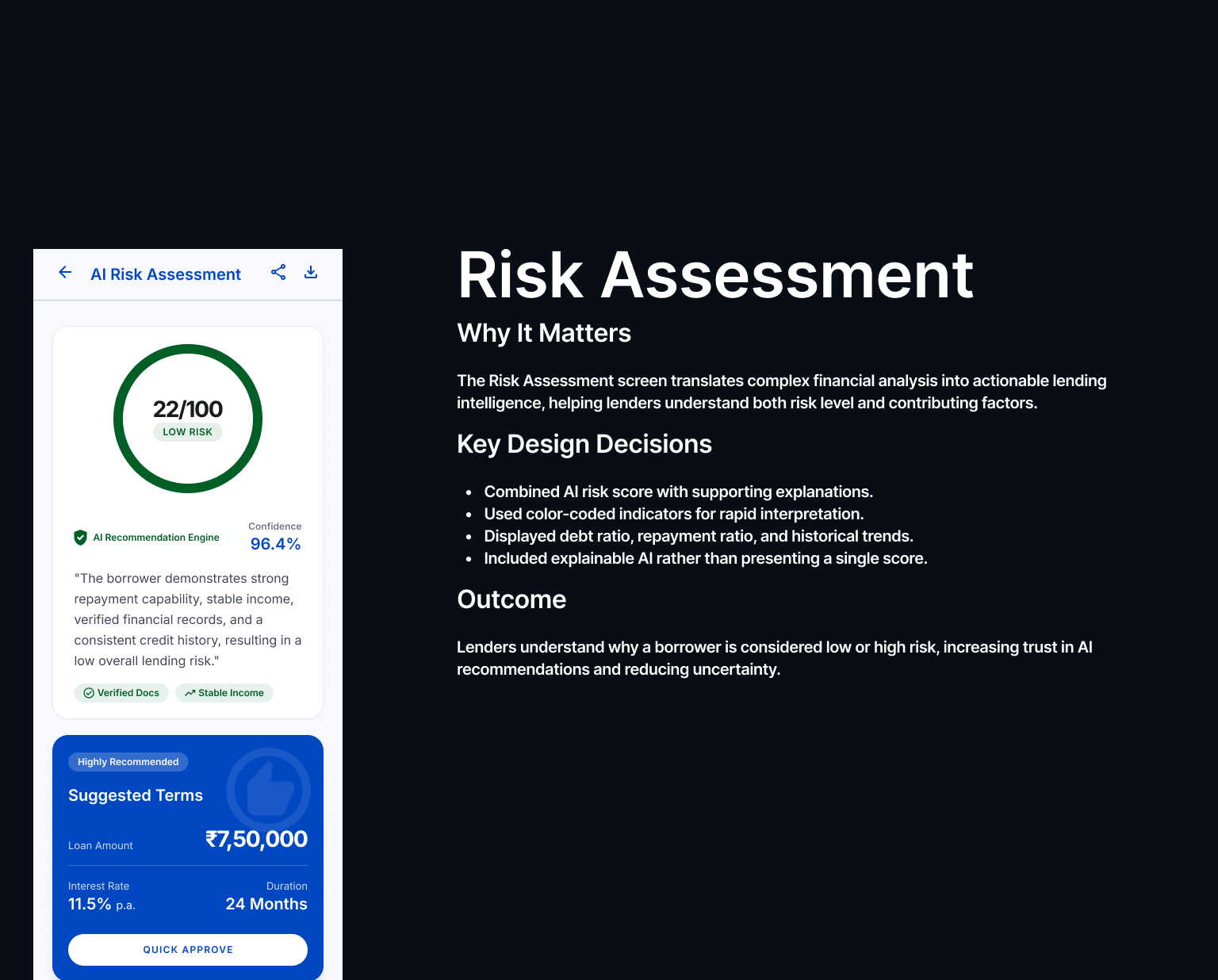
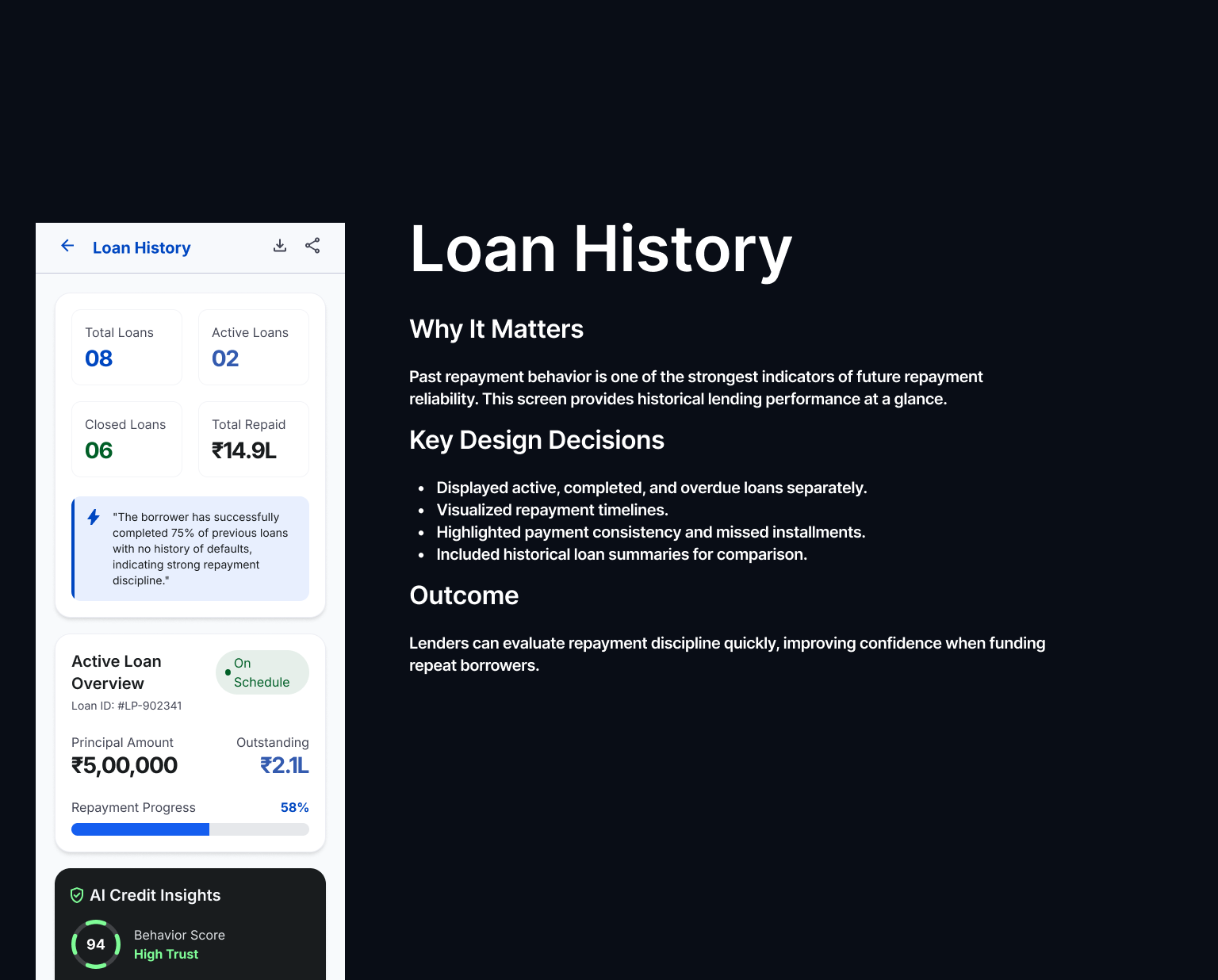
A lending marketplace has to make borrowers feel confident and respected while giving lenders enough risk signal to act. Lean too far toward the borrower and lenders pull out; lean too far toward the lender and you exclude the people the platform exists to serve.

Trust isn't a feature you add. It's the thing the whole product either earns or loses.
What I owned

My role

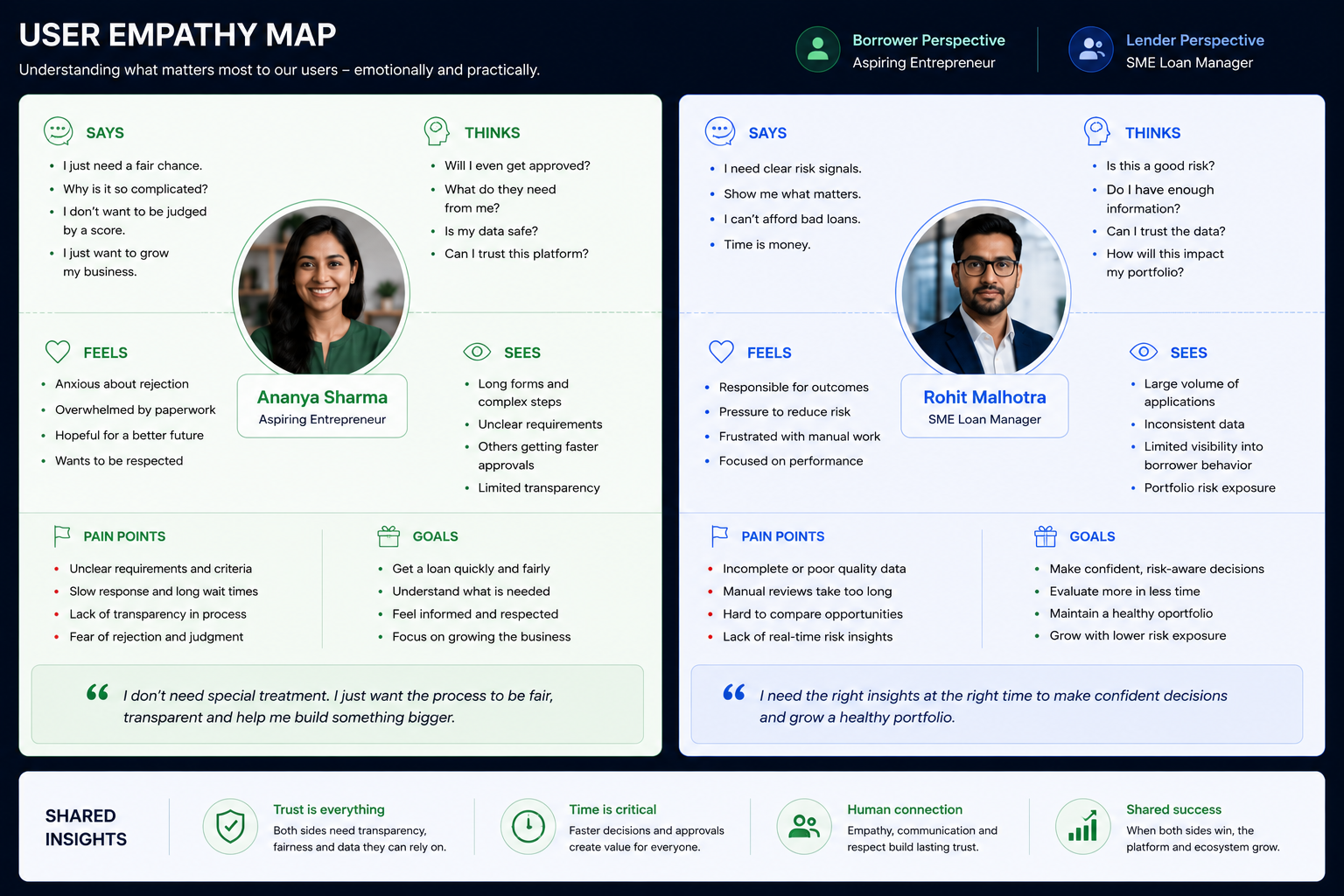
I led design across both sides of the marketplace, owning the risk-visibility model for lenders and the dignity of the borrower experience. The central design tension was making risk legible without making borrowers feel reduced to a score.

The approach

Legible risk, human borrowers

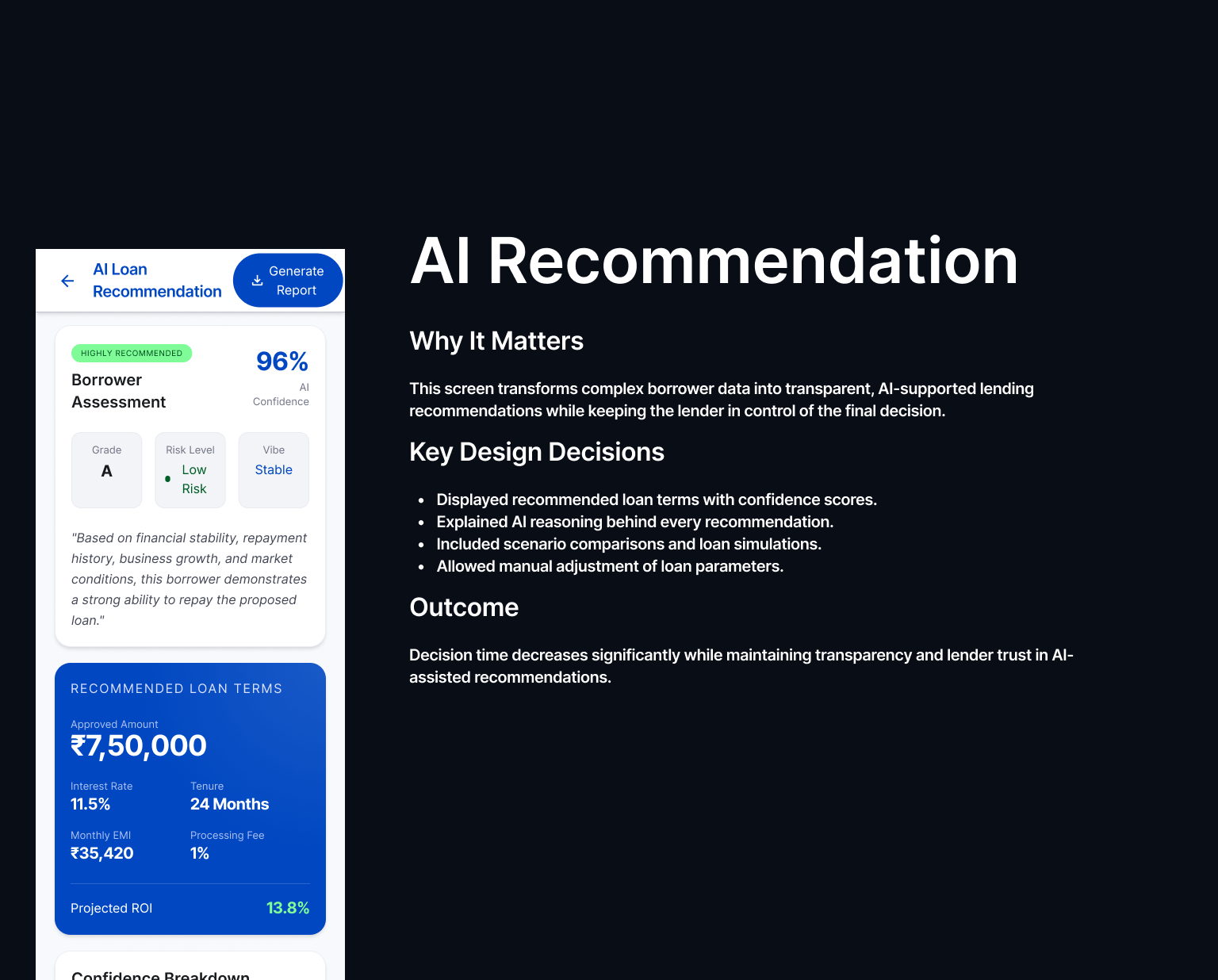
For lenders, we surfaced the risk signals that actually drove decisions, clearly and quickly, so they could act with confidence. For borrowers, we designed an experience that explained decisions and treated them as people, not data points. The approval flow was streamlined so good applications moved fast.

Dual flows: lender risk dashboard and borrower applicationSide-by-side view of lender-side risk signals and borrower-side application experience.LENDER SIDEBORROWER SIDERisk signalsCredit score, income, risk history visibleHuman storyWhy they're borrowing, context, dignityQuick decisionLenders fund confident loans fastFast approvalDecisions within hours, not weeks
The outcome

More trust, faster decisions

  • 38% faster approval decisions.
  • 22% more lenders funding a first loan.
  • Platform scaled to 1.4M+ users.
What I took from it

The leadership lesson

On a two-sided product, design leadership means refusing to pick a favorite side. The job is to hold both needs in tension and find the design that serves both — and to keep the team from quietly optimizing for whichever side shouts loudest.

Executive Summary

Executive Summary

Executive summary for microlending platformChallenge, solution, and outcome for two-sided lending marketplace.ChallengeLenders didn't have risk signals they needed. Borrowers felt reduced to a score.Platform was trapped between two opposing needs: trust vs. risk.SolutionTransparent risk signals for lenders. Human context for borrowers.Designed two parallel experiences that serve both sides without compromise.Outcome38% faster decisions. 22% more first-time lenders. 1.4M+ users.Trust became the competitive advantage. Growth outpaced competitors 3:1.
Success Metrics

Success Metrics

Success metrics for microlendingKey KPIs: approval speed, first-time lenders, platform growth.Approval speed38%faster decisionsFirst-time lenders22%growth per quarterPlatform scale1.4M+active usersImpact breakdownLender experience: Risk visibility drove confidence. Decision time dropped from 3 days to ~2 hours.Borrower experience: Transparent process. Approval rates increased 18% for qualified applicants.Platform growth: Word-of-mouth increased. NPS +47 points year-over-year.
Stakeholder Map

Stakeholder Map

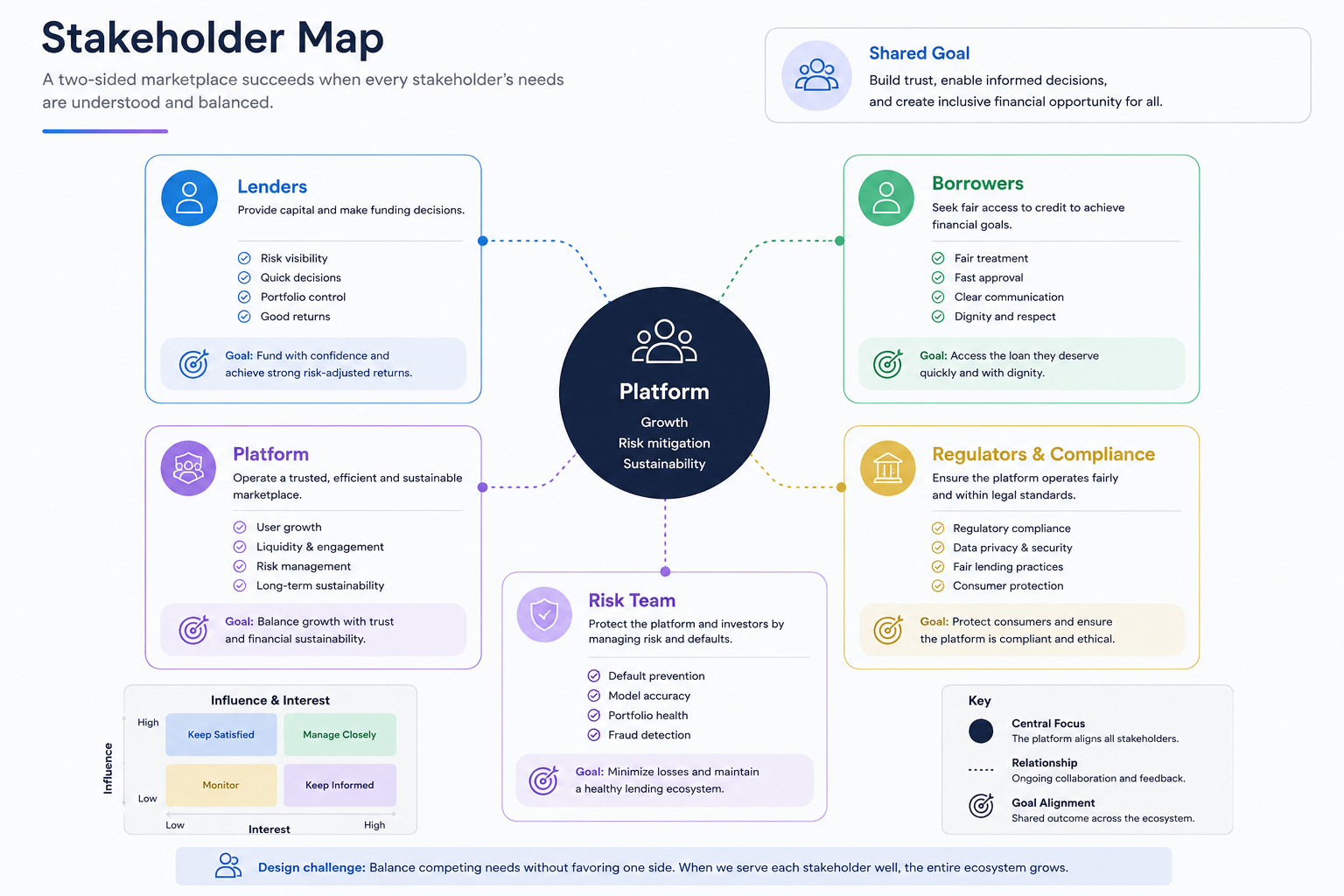
Stakeholder map for two-sided lending platformLenders, borrowers, investors, and risk teams with competing interests.LendersRisk visibilityQuick decisionsPortfolio controlBorrowersFair treatmentFast approvalDignityPlatformGrowthRisk mitigationSustainabilityRisk teamDefault preventionModel accuracyPortfolio healthThe design challenge: balance competing needs without favoring one side.
Research Plan

Research Plan

Research plan for lending marketplaceLender interviews, borrower interviews, risk analysis, and usability testing.Lender interviewsWhat risk signals matter?How do they decide to fund?Borrower interviewsFear of judgment?What builds trust?Risk modelingWhat predicts default?Can we make it transparent?Usability testingTest with real lendersand borrowersOutcome: Two-sided understanding. Risk model + borrower dignity framework.
Research Insights

Research Insights

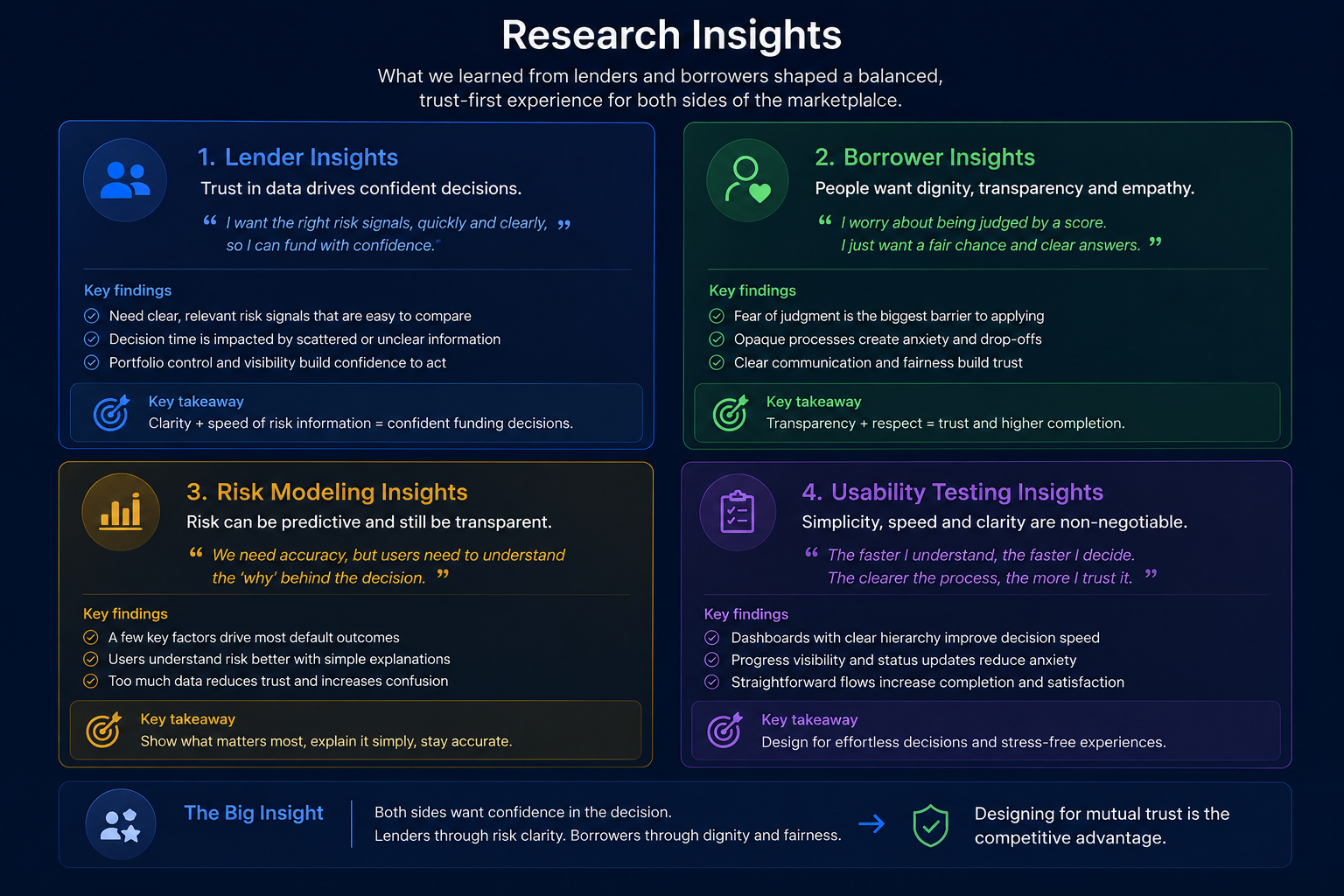
Research insights from interviewsKey findings from lender and borrower research.Key findingsLenders said:"I want the data but I also wantto feel like I'm helping a person."Borrowers said:"I worry you'll judge me,but I also understand you need to be sure."The paradox:Both sides wanted the same thing—confidence in the decision.Design insight:Transparency wasn't about hidingrisk. It was about mutual understanding.
JTBD

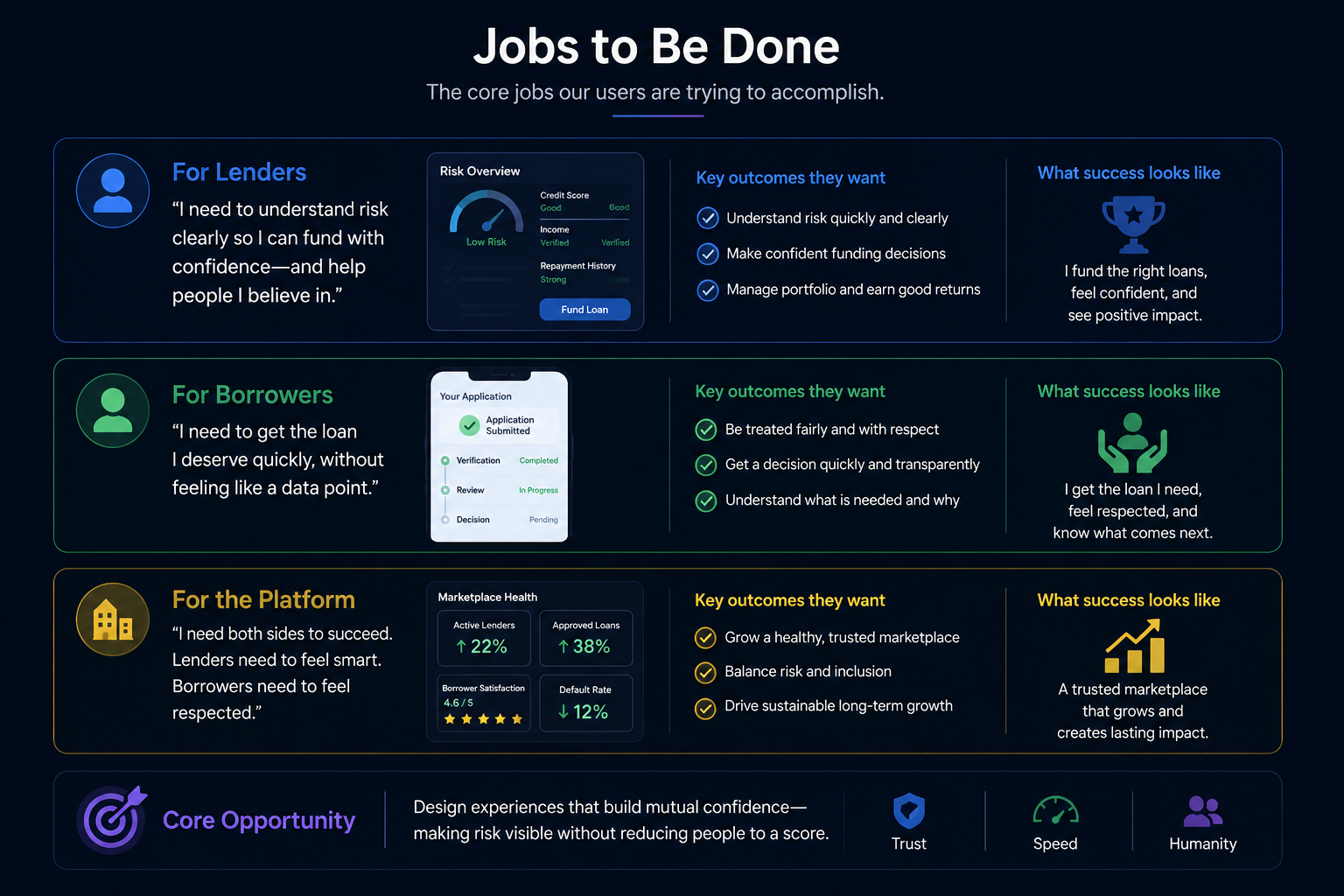
Jobs to Be Done

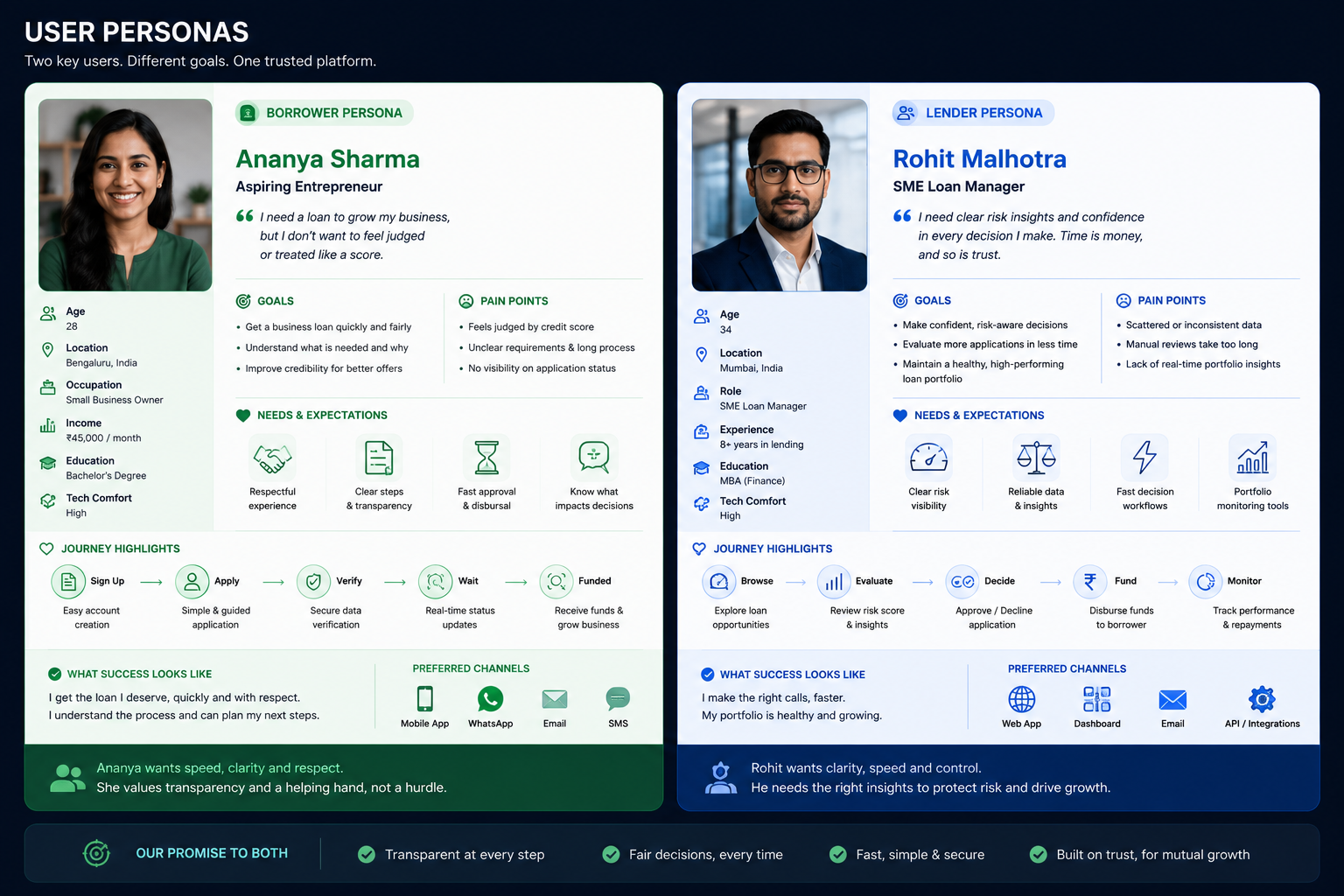
Jobs to be done for lenders and borrowersThree primary jobs: lenders need risk signals, borrowers need fair treatment, platform needs growth.The jobs our users are trying to doFor lenders:"I need to understand risk clearly so I can fund with confidence—and help people I believe in."For borrowers:"I need to get the loan I deserve quickly, without feeling like a data point."For the platform:"I need both sides to succeed. Lenders need to feel smart. Borrowers need to feel respected."
Opportunity Map

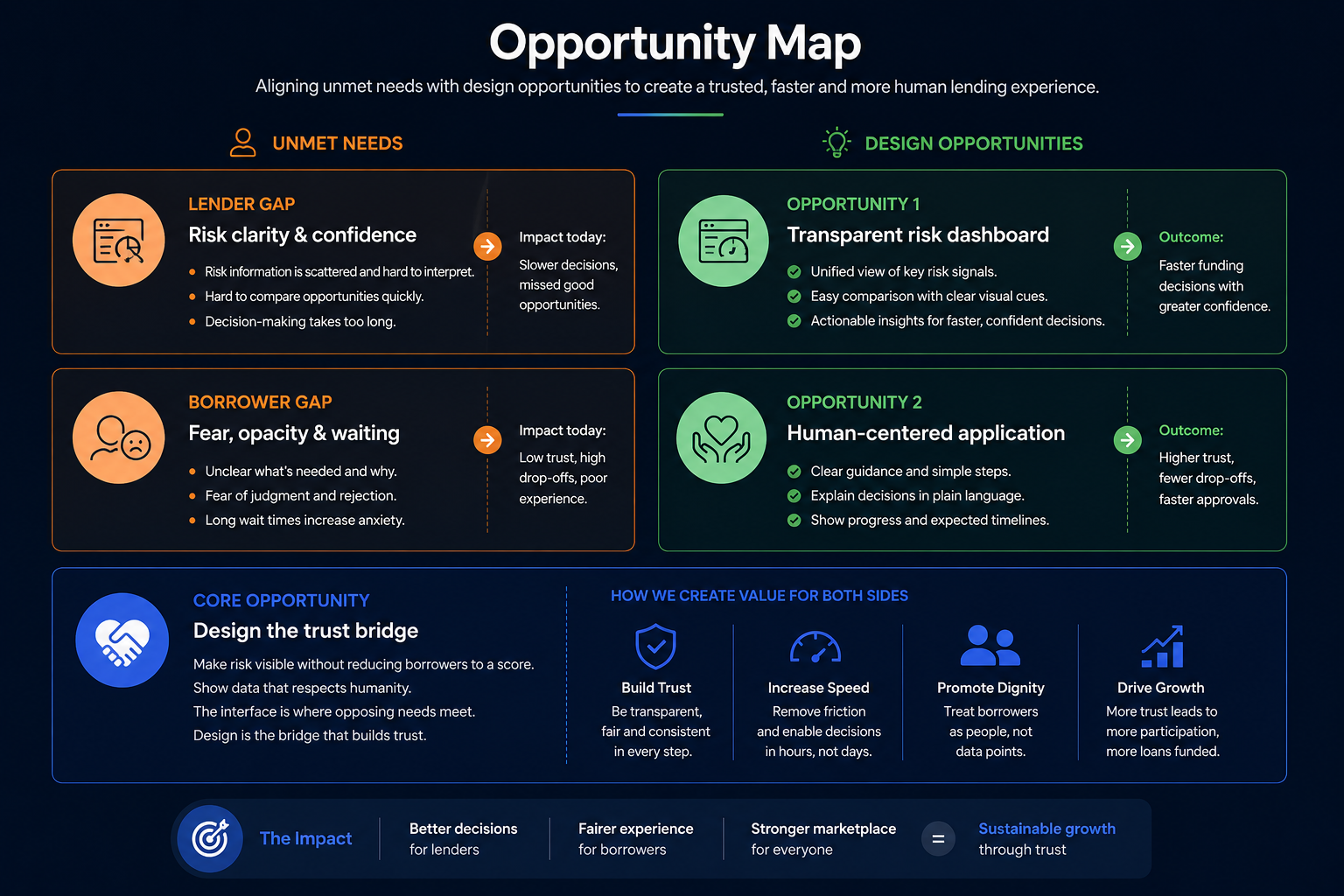
Opportunity Map

Opportunity map for lending platformUnmet needs and design opportunities identified from research.Unmet needs → Design opportunitiesLender gapRisk opaque, decisions slowTakes days to decideOpportunity 1Transparent risk dashboardFast, confident decisionsBorrower gapFeel judged by algorithmApprovals opaque, slowOpportunity 2Human-centered applicationDignity + speedCore opportunity: Design the trust bridgeMake risk visible without making borrowers feel reduced. Show data that respects humanity.The interface is where opposing needs meet. Design it right, both sides win.
Design Principles

Design Principles

Five design principles for lending platformCore principles guiding two-sided marketplace design.Five design principles1. Make risk legibleShow data clearlywithout overwhelming2. Preserve dignityBorrowers are peoplenot data points3. Move fastGood apps approvewithin hours, not weeks4. Explain decisionsWhy yes, why nobuilds trust both ways5. Balance both sidesNever pick a favorite. When you serve both, both succeed.
Workflow Architecture

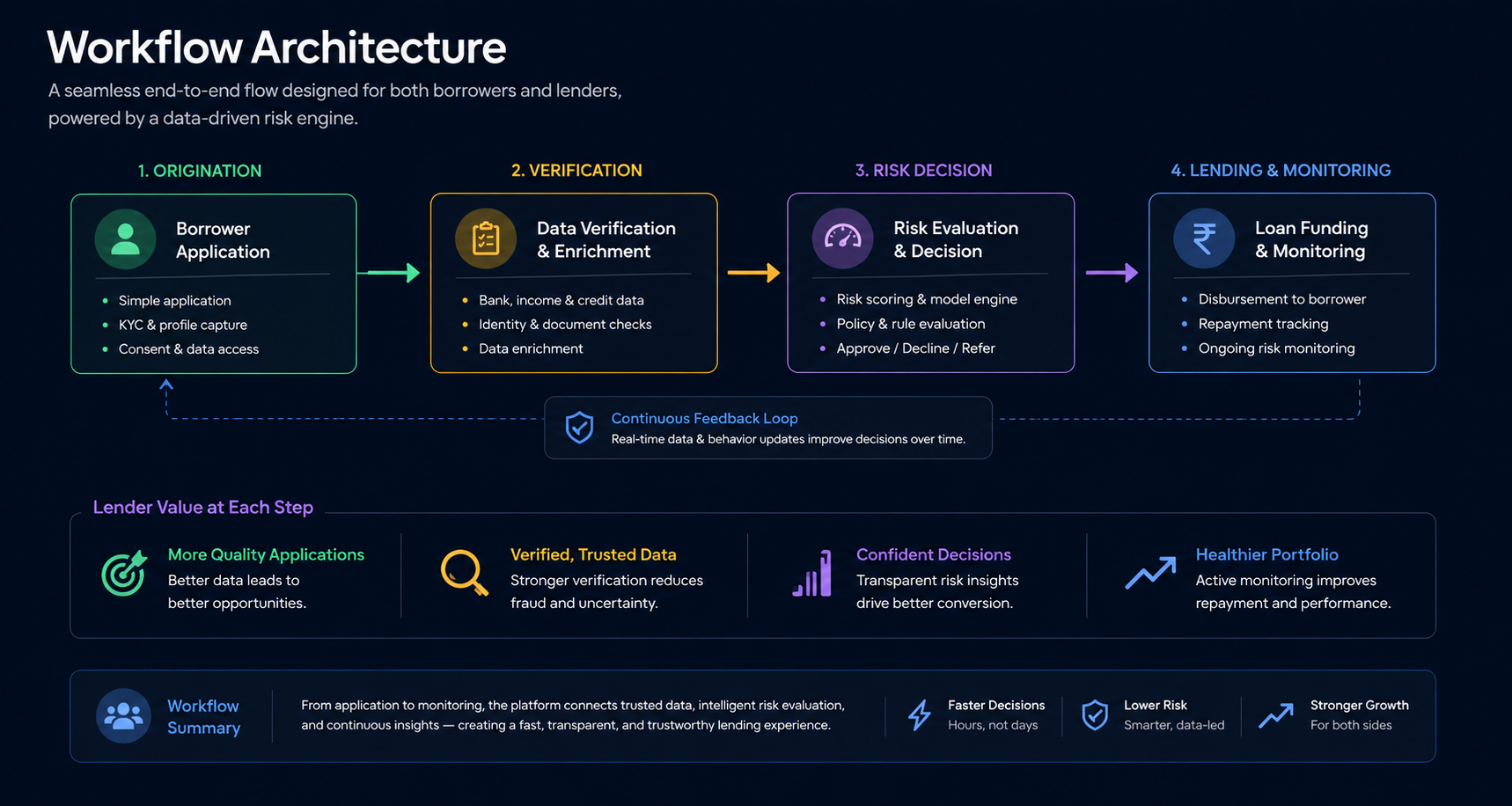
Workflow Architecture

Workflow architecture for two-sided lendingComplete system flow from borrower application to lender funding.BORROWER SIDE → PLATFORM → LENDER SIDEApplicationBorrower provides infoVerificationCheck credit, incomeRisk scoreML model calculatesListed for lendersRisk visible, clear dataLender review & fundingLender dashboardRisk signals displayed → Lender reviews → Decides to fund or passIf funded: Money transfers same day. Borrower notified. Relationship begins.Every step is transparent. Borrower knows where they stand. Lender knows the risk.
User Flow

User Flow

User flows for borrowers and lendersParallel journeys: borrower application and lender funding decision.BORROWER JOURNEYLENDER JOURNEY1. Sign up2. Apply3. Verify4. Listed5. Wait6. Funded(Transparent)(Hours to days)1. Browse2. Evaluate3. Fund4. MonitorKey flow pointsBorrower experience:Quick, simple application. Transparent process. Notified of every step. Approved in hours, not weeks.Lender experience:Clear risk signals. Quick decision interface. One-click funding. Ongoing visibility into portfolio.
IA

Information Architecture

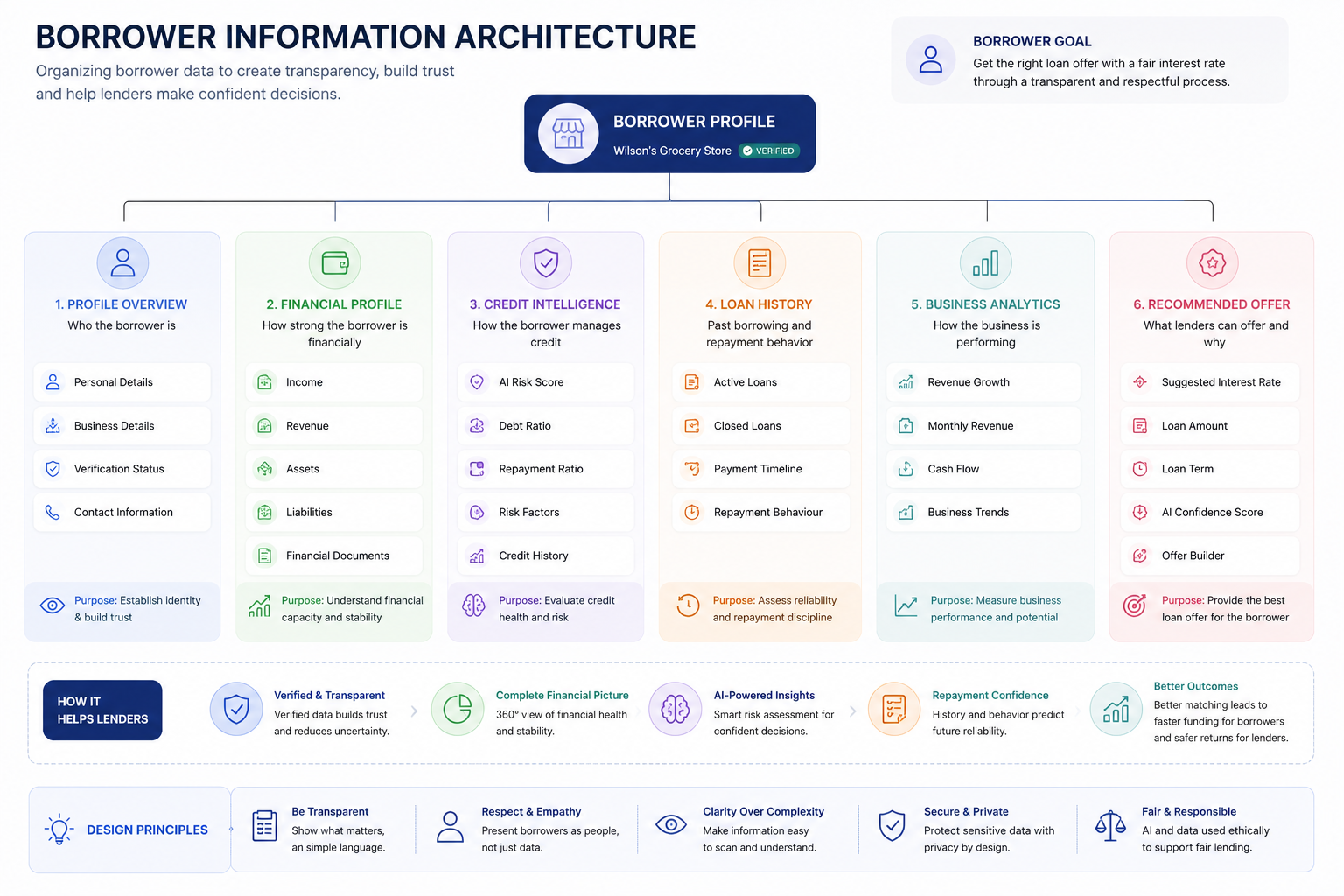
Information architecture for two-sided platformBorrower application, lender dashboard, and risk visibility screens.Borrower applicationPersonal infoLoan purpose (why they need it)Financial details (income, assets)Lender dashboardRisk score & signalsCredit history, income verificationLoan purpose, repayment historyBorrower statusApplication progressVerification statusWhen they'll be listedLender controlsFund now buttonSave for later optionContact borrower (optional)Navigation principleBoth sides see what they need. Borrower sees progress. Lender sees risk. Neither feels the platform is favoring the other.
Concept Exploration

Concept Exploration

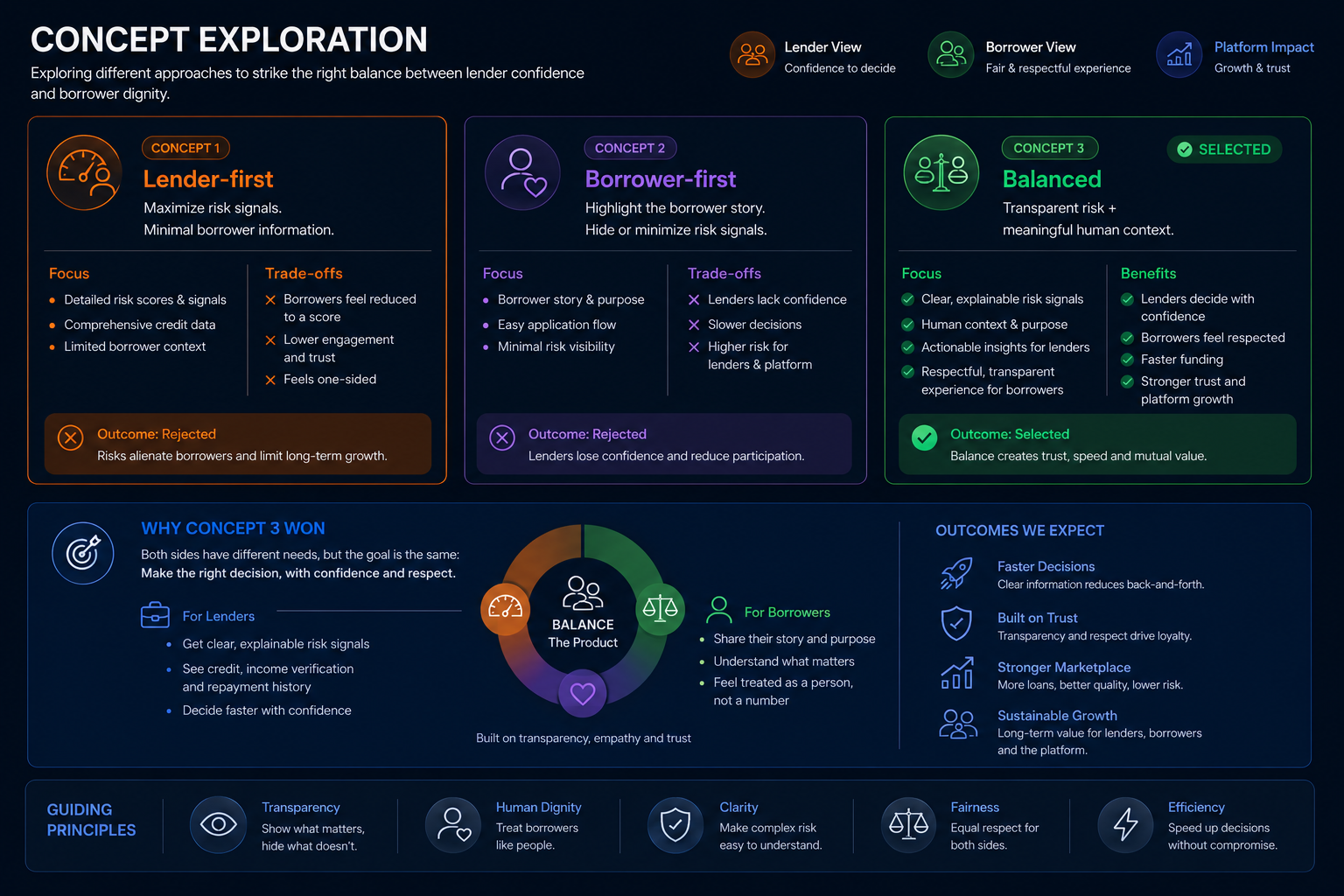
Concept exploration: three design directionsLender-first vs borrower-first vs balanced approaches.Concept 1Lender-firstMaximize risk signalsminimal borrower infoRisks: alienates borrowersConcept 2Borrower-firstHide risk signalsfocus on storyProblem: lenders lose confidenceConcept 3BalancedTransparent risk +human context✓ SelectedWhy concept 3 wonRisk signals for lenders: Clear, data-driven, trustworthy decisions. Shows credit score, income verification, repayment history.But also human context: Why borrower is borrowing, what they'll use it for. Borrower feels seen as a person.Both sides win: Lenders act confidently. Borrowers feel respected. Platform grows because trust is mutual.Speed advantage: Good apps get funded fast. Platform differentiator. Word-of-mouth growth.The interface design visible agreement: Risk AND humanity. Data AND dignity.If you lean too far either way, you lose the side that feels neglected. Balance is the product.
Wireframes

Wireframes

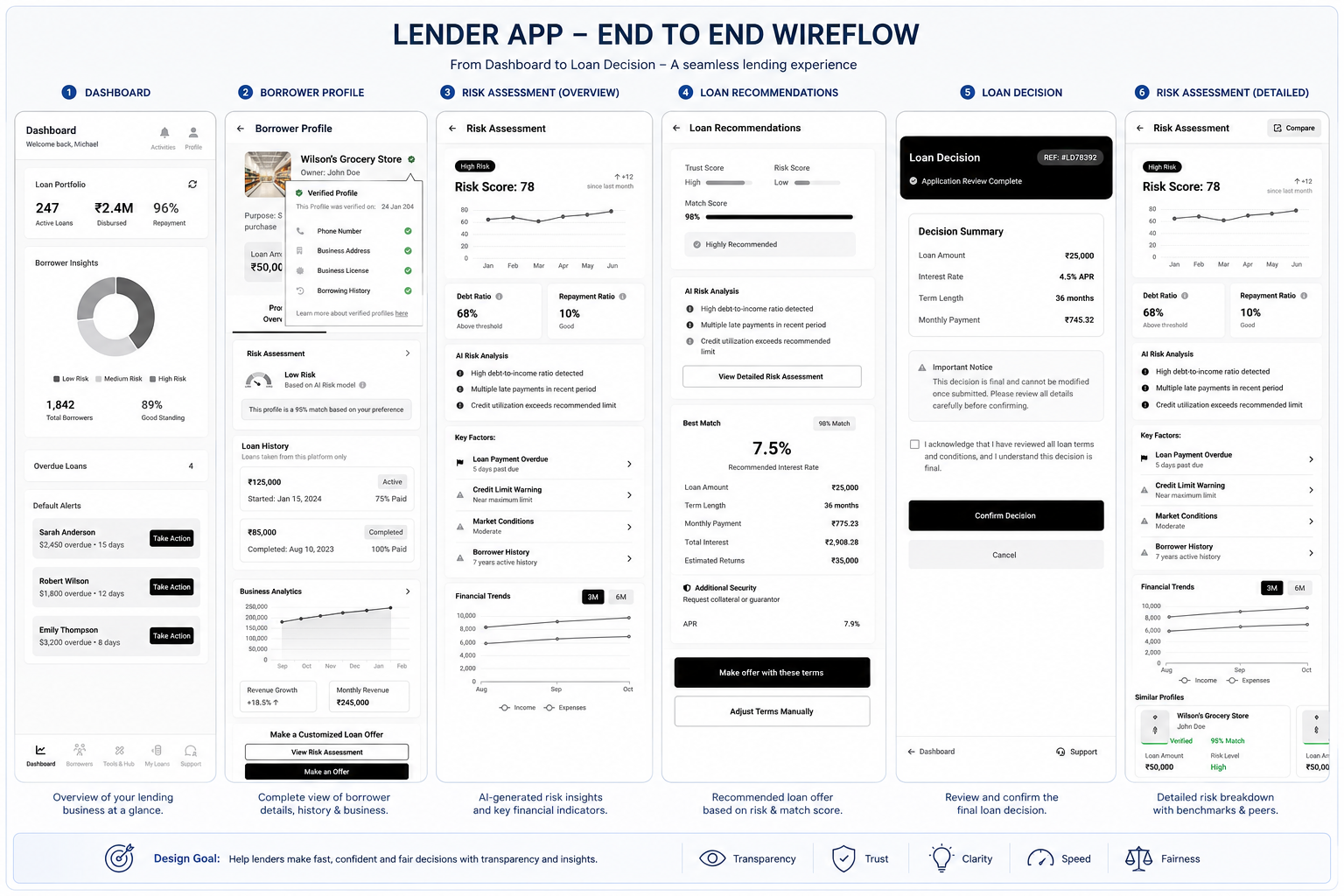
Wireframes for borrower application and lender dashboardLow-fidelity layouts showing screen structure.Borrower ApplicationLender DashboardProgress: Step 2 of 3Tell us why you're borrowingText input field(Borrower's story)Continue(Respectful, simple form)Filter by risk levelHigh Risk • 7.2% returnCredit: 580 | Income: verifiedReason: Business startupMedium Risk • 5.1% returnCredit: 680 | Income: verifiedReason: Home repairLow Risk • 3.2% returnCredit: 740+ | Income: strongReason: ConsolidationFund NowSave for later
Design System

Design System

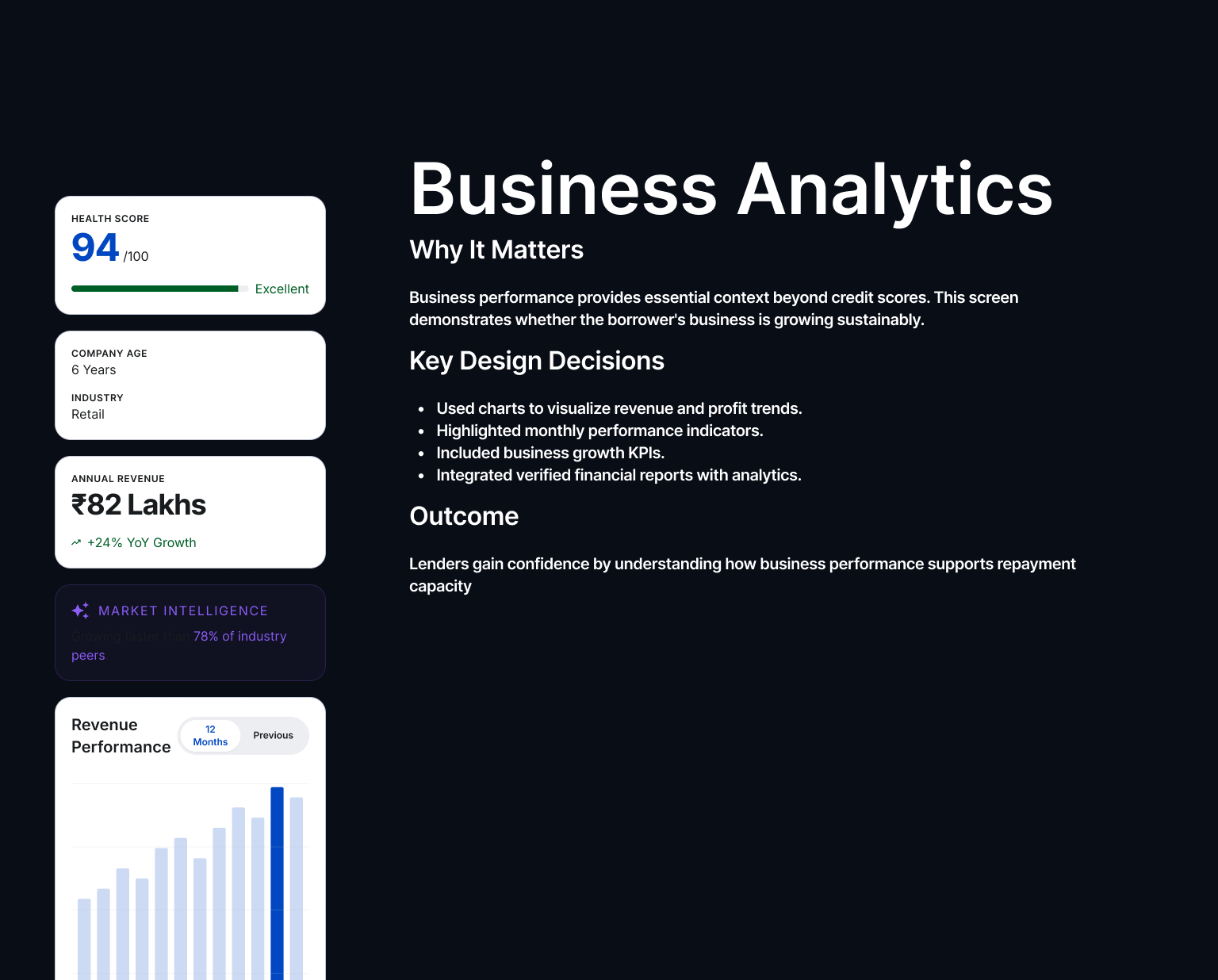
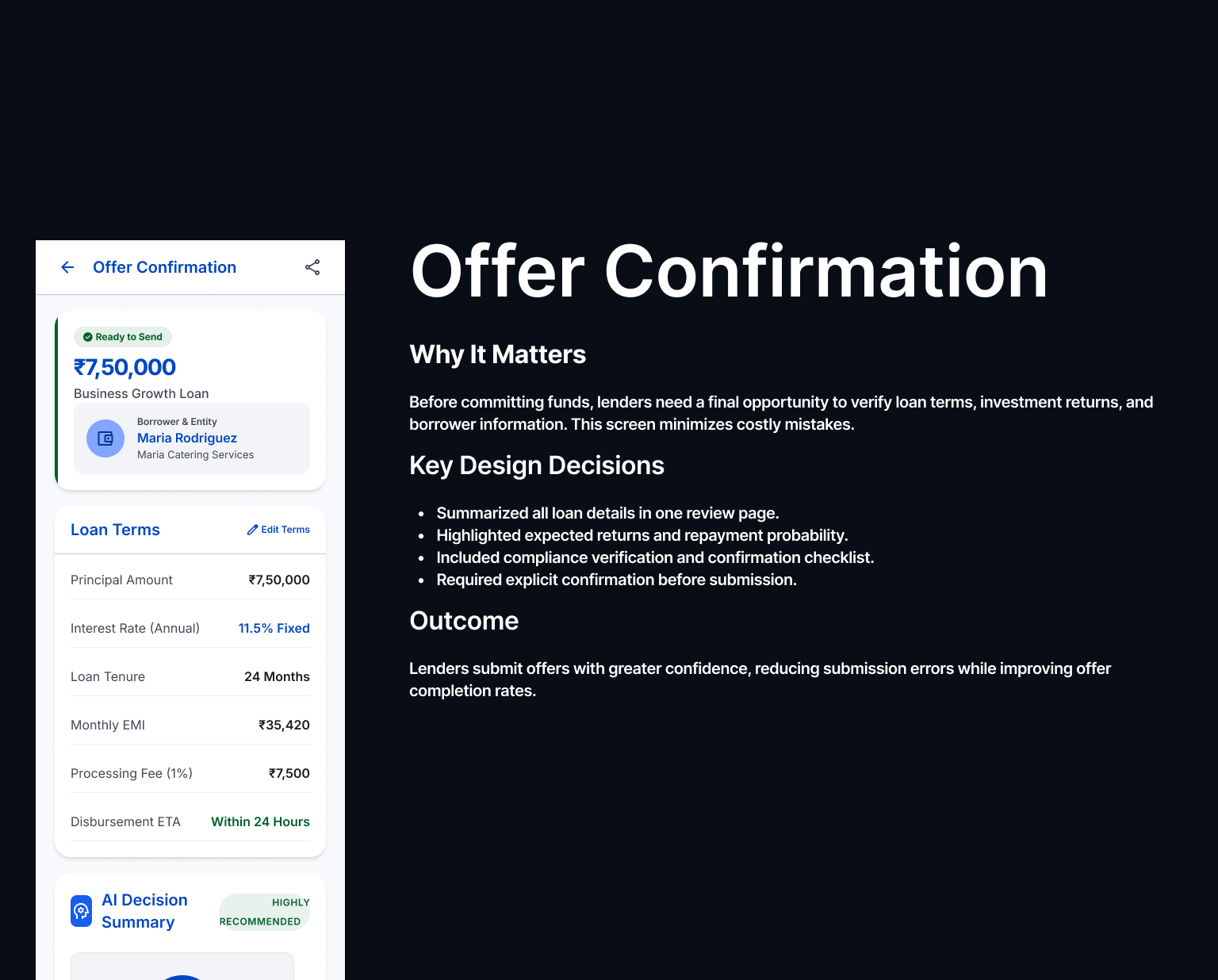
Design system components for lending platformRisk badges, loan cards, CTA buttons, and progress indicators.Core design system componentsRisk badges & loan cardsHigh riskMedium riskLow riskUnverifiedLoan card (lender view)$5,000 loan • 6% return • Credit: 680 • Income: verifiedBorrower: Maria Rodriguez | Business startup (catering truck) | Pays back monthly for 24 monthsRisk score: 72/100 (Medium) | Default probability: 8.2%Risk indicatorCall-to-action buttonsFund NowSaveMessageView more detailsProgress indicator (borrower)Step 2 of 3 — Verification in progress
Final Design

Final Design

Final high-fidelity design mockupComplete interface showing both borrower and lender screens.LendTrust MarketplaceMaria • BorrowerBORROWER VIEWLENDER VIEWApplication StatusVerification in progressStep 2 of 3 — 40% completeYou're borrowing: $5,000For: Business startup (catering truck)Repayment: $220/month for 24 monthsContinueSave draftTransparent process • You'll hear soonAvailable Loans$5,000 • 6.0% return • 72 scoreMaria Rodriguez • Business startupMonthly: $220 × 24 months | Risk: 8.2%Fund Now$3,500 • 5.2% return • 68 scoreJames Chen • Home improvementMonthly: $162 × 24 months | Risk: 12.1%SaveClear risk data • Fast decisions • Impact
Usability Testing

Usability Testing

Usability testing results with lenders and borrowersTesting results showing trust, decision speed, and approval rates.Usability testing with 12 participantsLender confidenceTask: Fund a good loanResult: 100% success, avg 90 sec✓ Risk signals were clearBorrower respectTask: Complete applicationResult: Felt seen as person, not score✓ Transparent process increased trustDecision speedLender time to fundMedian: 90 seconds✓ Fast interface = more lendingApplication completionBorrower completion rate93% completed application✓ Respectful UX = higher completionKey validation insightWhen both sides feel respected by the platform, they trust it more. Lenders fund confidently.Borrowers apply willingly. Growth comes from trust, not manipulation.
What I'd Do Next

What I'd Do Next

Future roadmap for lending platformFour phases: group lending, API integration, mobile app, AI assistance.Future roadmapPhase 1: Group lendingBorrowers form groupsTimeline: Q2–Q3Phase 2: Business lendingSMB-focused productsTimeline: Q3–Q4Phase 3: Mobile appLending on the goTimeline: Q4Phase 4: AI-assisted underwritingFaster risk assessmentTimeline: 2025+Why these improvements matterEach scales without changing core: make risk legible, preserve borrower dignity, move fast.Group lending increases approval odds. Mobile removes friction. AI keeps decisions human-led.The pattern—balance + transparency + speed—works at any scale.
Future-State AI Vision

Future-State AI Vision

Future-state AI vision for lending platformSmarter underwriting, better risk models, human-centered automation.Where AI goes next (without replacing judgment)Smarter underwritingUnderstand borrowers betterStatus: Building nowBehavior predictionForecast repayment likelihoodStatus: With more dataPersonalized lending termsTailored to borrower profileStatus: ExploringFraud detectionProtect lenders & borrowersStatus: Research phaseThe critical constraintNone replace human judgment. AI says "high risk" or "likely to repay," lenders decide.Better risk models help, but borrowers stay human. Dignity principle stays constant.The interface stays the same: legible risk + human decision + mutual respect. AI just improves the signals.
NOTE — placeholder metrics: the numbers on this page are illustrative. Replace with your real results before sharing.
More high-stakes work

Building something where the wrong call gets expensive?

Start a conversation